
In a rare move that might end the chronic impasse between arch-enemies the United States and Iran, President Barack Obama could meet his Iranian counterpart Hassan Rouhani on the sidelines of the United Nations General Assembly.

The readouts by the Indian and Chinese sides on the meeting on Monday between External Affairs Minister Sushma Swaraj and her Chinese counterpart Wang Yi in Moscow bring out that divergences are crowding into the centrestage of their relationship, says Ambassador M K Bhadrakumar.

'It is highly doubtful that the Trump administration will consider inserting itself into the volatile India-Pakistan dispute.'

'We will have to wait till the snows melt in June/July 2016 before we can get a clearer idea of whether Pakistan intends to get serious about ending support for cross-border terrorism,' says G Parthasarathy, India's former high commissioner to Pakistan.

It emerges that not only does the CIDR project fails the test of fairness, justness and reasonableness besides the test of not being fanciful, oppressive or arbitrary; it also fails the test of Arthashastra, Hadith and the Bible.

Aziz Haniffa, who has covered every Indian Prime Minister's visit to the US since Rajiv Gandhi in 1985, gives us a peek into what's happening in Washington, DC on the eve of the Modi-Trump summit.

Why is Xi Jinping visiting Saudi Arabia, Egypt and China this week? Former RA&W officer Jayadeva Ranade explains the significance of China's outreach to the Middle East.

20 years ago this day, May 11, 1998, India conducted its second nuclear test at Pokharan in Rajasthan. In a fascinating interview on Rediff.com, K Subrahmanyam revealed how Indian PMs reacted to nuclear ambitions.

'India was in no position to wage another war in 1965, having suffered a morale-shattering defeat in 1962. The three services were in the middle of a modernisation and expansion phase and therefore not fully trained or battle-ready.'

The following is the full text of US President Donald Trump's first address to a joint session of the Congress on February 28, as prepared for delivery and released by the White House press office.

Two US warships fired at least 50 cruise missiles at the Ash Shai'rat airfield in Homs province in western Syria, from where the US administration believes Syrian President Bashar Al-Assad fired the chemical weapons against his own people, media reports said.

Kashmir remained on the edge with six more persons, including a cop getting killed in violence on Sunday.

'For its part, Pakistan often gives safe haven to agents of chaos, violence, and terror.'

'The present government's greatest weakness is its intolerance. Tolerance is the key tenet of democracy. How can any government stop someone from speaking one's mind?'
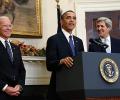
'The threat that India faces and the threat the United States faces is not just to the homeland, but to our people and to our institutions wherever they may be.' In an exclusive conversation with Aziz Haniffa/Rediff.com, US Assistant Secretary of State Nisha Desai Biswal outlines the importance of Prime Minister Modi's visit for America.

Like China, India needs to encourage 'hacker clubs' in view of the challenges of virtual terrorism, says Lieutenant General Prakash Katoch (retd)

With Beijing having had a profound rethink on India's admission as a full member of the Shanghai Cooperation Organisation, the tectonic plates of the geopolitics of a massive swathe of the planet stretching from the Asia-Pacific to West Asia are dramatically shifting. That grating noise in the Central Asian steppes will be heard far and wide -- as far as North America, says Ambassador M K Bhadrakumar.

'The real test will be in defence-related deals, for instance the Javelin anti-tank missile: Is the US willing to co-develop something with India, on terms that will support the 'Make in India' initiative? Is there defence technology transfer? Or will it dump old junk on India?' asks Rajeev Srinivasan.

'The obsession of the Pakistan army with India leads to several destabilising things. Support for the Taliban in Afghanistan. Support for groups like the Lashkar-e-Tayiba, that have attacked India. Every time you get an attack like that there is a possibility of a war. And then the build up of the their nuclear arsenals. Chances of a nuclear weapon landing in the hands of a terrorist group, or a nuclear war breaking out, are tiny. But they are higher here than anywhere else in the world.'
